A Winter Garden Seen in Silhouette
A winter garden silhouette reveals where stems, branches, and structures carry the view, helping you decide what to preserve, prune, move, or open.
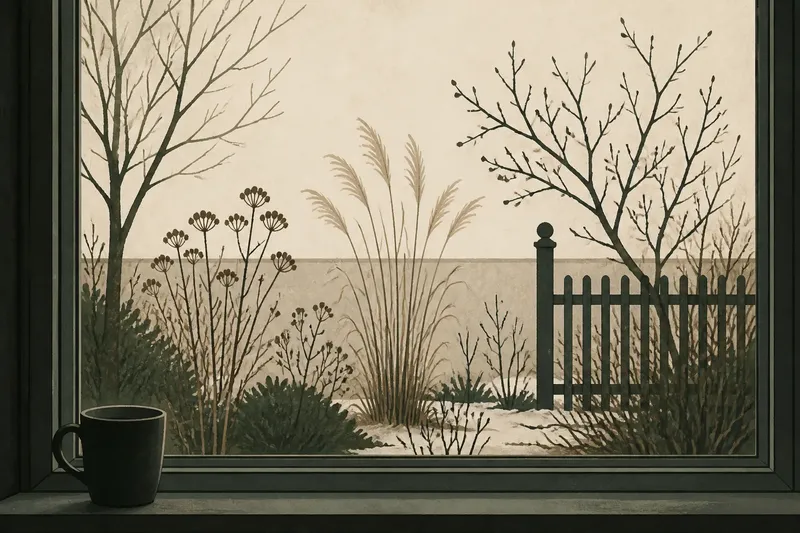
What does your garden look like when its leaves stop doing the explaining? A winter garden silhouette makes the answer visible: stems, branches, fences, and other structures stand against open space, showing whether the bare-season composition feels balanced, crowded, or unfinished.
This is an observation exercise, not a pruning plan. Choose a view, look at the outlines, and decide what kind of visual problem you actually have before reaching for shears. The right response depends on whether the view needs clearer separation, a stronger outline, or simply more time to be seen.
How should you set up a winter garden silhouette?
Start from a place where you naturally pause: a kitchen window, a back step, or the end of a path. Look outward toward a plain background if one is available. A pale wall, cloudy sky, or undisturbed fence makes outlines easier to read than a busy view through several layers of planting.
Choose one viewing position and stay there for a few minutes. Notice what appears as a distinct shape and what merges into a single mass. Then shift a few steps to one side. A branch that seemed separate may overlap a post; a thin clump of stems may disappear against a dark hedge. The change is useful information, not a reason to keep hunting for a perfect angle.
For a simple record, sketch only the largest outlines and the gaps between them. A phone photograph can also help, especially if you take it from the same position again later in the season. Avoid trying to identify every twig. The aim is to understand the composition at a glance, not to produce a botanical inventory.
Does the view feel crowded or tangled?
If several outlines overlap until they read as one dark patch, the view may need more separation. This is common where a shrub, a cluster of perennials, and a fence sit close together in the same sightline. The issue is not necessarily that there are too many plants; it may be that their shapes occupy the same visual plane.
First ask whether the overlap is temporary. Some perennials hold dry stems that look loose from one angle and dense from another. A change in viewing position may reveal a more legible arrangement. If the tangle remains, consider whether one element could be shifted, thinned, or allowed to grow into a more distinct outline over time.
Say you look from a kitchen window and see a young ornamental grass merging with the dark lower branches of a shrub. Imagine moving the grass to an open patch nearer the path, while leaving the shrub in place. The expected observable result would be two separate outlines, with a visible interval between them from that window. If moving either plant would disrupt its growing conditions or the rest of the garden, leave it and revisit the view before making a larger change.
Is the garden too bare against the sky?
Open space can make a garden feel calm, but a large blank area may leave the view without a useful outline. Look for places where the eye has no clear boundary to follow: a low bed ending abruptly beneath a broad stretch of sky, for instance, or a narrow tree shape isolated from the rest of the scene.
If that is what you see, the answer may be to add or retain one upright or branching form rather than fill the whole space. A small tree, a shrub with a clear winter outline, or a trellis can give the view a visible edge. Choose a form that suits the available space and the garden’s growing conditions; a silhouette is not a reason to install a plant that will later outgrow its setting.
Also check whether the apparent blankness is seasonal rather than permanent. A bed of herbaceous perennials may look quiet after its foliage has died back, while nearby evergreen planting keeps the wider view connected. If the garden is already composed around spring or summer growth, the bare outline may be a brief interval rather than a design failure.
Do individual stems and branches read clearly?
When stems stand out against an open background, their direction and spacing become part of the view. Upright stems can draw the eye upward; arching branches can make a boundary feel softer; a branching shrub can create a fine web against a light sky. Notice whether these forms seem intentional together, or whether one shape interrupts the others.
Thin stems often show best against a pale background, while darker branches may be easier to read against snow or a light wall. A plain analogy helps: outlines work like the bars of a chair against a blank wall. They are easiest to understand when the space around each bar remains visible.
Do not assume that every stem needs to be cut back for neatness. Some dry seed heads and standing stems may contribute shape, texture, or food and shelter for wildlife. If you are deciding whether to remove them, consider their condition and purpose as well as their appearance. Where the right choice depends on a plant label, manufacturer instructions, or local rules, check those once before acting.
Which winter garden silhouette fits your situation?
What if I can only see the garden from indoors?
Use the window as your fixed viewpoint and include its frame in the observation. The frame acts like a picture border, helping you judge how stems and structures sit within the visible area.
What if the background is a dark hedge?
Look for lighter sky or a pale surface behind the forms, or shift sideways until the outlines separate. If neither is possible, focus on the outer edge of the planting rather than trying to read each stem within the dark mass.
What if wind keeps changing the outlines?
Watch the plants briefly while they move, then judge their resting shape as well. Flexible stems may form a changing pattern, so the useful question is whether that movement feels coherent from the places where you spend time.
What if snow hides the lower garden?
Use the visible branches and structures to assess the upper composition, and postpone judgments about low planting until it is exposed again. Snow changes the background and conceals detail; it is not a reliable picture of the whole bed.
What should you preserve, change, or simply observe?
Once the outlines are clear, sort what you see into three practical decisions:
- Preserve: keep a distinctive branch, stem group, or structure that reads clearly and gives the view a useful edge.
- Separate: consider a modest adjustment where two forms merge and the overlap makes both difficult to read.
- Add: consider a restrained upright or branching form where the open view feels unsupported.
- Wait: defer a decision when the view depends on temporary snow, wind, or a plant that has not yet settled into its mature shape.
- Recheck: return from the same viewing position after a seasonal change to see whether the outline has altered.
These are choices about visual character, not universal instructions. A garden can be deliberately dense, open, or irregular. What matters is whether the bare-season view feels like the garden you intend to see, rather than an accidental tangle or a gap you meant to address.
A winter garden silhouette is most useful when it changes what you notice before it changes what you do. Keep the sketch or photograph, and let it guide one considered decision: preserve a strong outline, create a little separation, or leave the view alone. Sometimes the best design move is to recognize that a quiet garden has already made its point.