The Focal-Point Myth: A Garden Can Have More Than One Centre
A garden can have more than one focal point. Learn how to space smaller moments so the eye moves naturally instead of getting stuck in one place.
Can a garden have more than one focal point? Yes—and a garden with several modest points of attention can be easier to read than one built around a single commanding object. The trouble starts when those points compete, disappear from the paths where they matter, or leave visitors unsure where to look next.
A focal point is simply a place that catches the eye: a pale-barked tree, a bench at the end of a path, a pot with a distinctive shape, or a glimpse of water. It need not be a sculpture on a plinth. Think of focal points as lamps in a hallway, not spotlights on a stage: each can help orient you without demanding the whole room.
Here are common layout problems, what tends to cause them, and what to adjust. The aim is not to add more features by default. It is to make each point of attention earn its place in the visitor’s route.
Why does the garden still have one obvious center?
A strong central object can take over even when the garden contains other interesting details. A large urn in the middle of a lawn, for instance, may be visible from every path and framed by open space. Nearby objects then read as decoration around the urn rather than as independent destinations.
The cause is often not the object itself, but its position and exposure. A feature placed on the main axis, isolated against a simple background, and seen from the entrance gets an advantage. Smaller details can’t compete if they sit in busy planting or are revealed only after a visitor has passed them.
Try shifting the hierarchy rather than removing the central feature. You might move a bench off the direct axis, partly screen it with a shrub, or make a second point of interest visible from the entrance at an angle. A change in viewpoint can give the eye two places to visit without making both equally prominent.
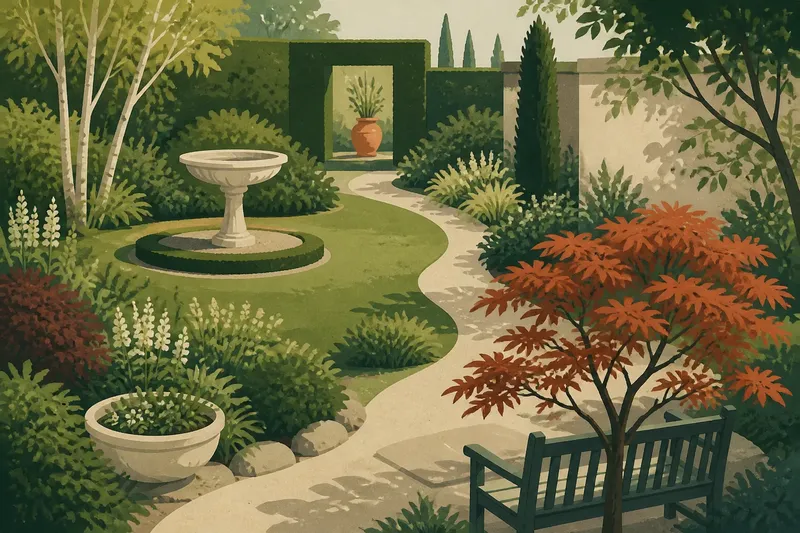
Say you have a round birdbath centered on a lawn and a small red-leafed tree beside the side path. If the birdbath dominates the entrance view, imagine moving the bench to face the tree and letting a clipped hedge frame the birdbath from the opposite path. The expected result is that someone entering sees the birdbath first, then notices the tree while turning toward the bench, rather than reading the entire garden as a view of one object.
Why do several focal points feel like clutter?
Several points of attention become visual noise when they have similar weight and crowd one another. A bright pot, a carved stone, a vivid flowering shrub, and a reflective ball may each be attractive alone. Together, especially in a compact bed, they can produce a sequence of competing demands instead of a route for the eye.
Look for repeated signals of equal strength: saturated color, unusual shape, strong contrast, or an object set apart from its surroundings. The issue is not that a garden has too many features in the abstract. It is that too many features are asking for first place from the same viewing position.
Give the points different roles. One can be a clear destination, another a quiet discovery, and a third a marker that turns the visitor toward the next area. Reduce the contrast of one feature, put it against a calmer background, or let foliage partly obscure it. A focal point does not lose its usefulness simply because it is not visible all at once.
It helps to consider the view from a seated position as well as from standing height. A low stone bowl may be prominent from a bench but nearly vanish from the gate. A small tree with a distinctive branching shape may work from both. The right mix depends on where visitors pause and what they can see from those positions.
Why do the points of interest disappear from the route?
A feature can be handsome and still fail as a guide if no one sees it at the right moment. This often happens when a focal point sits behind a hedge, faces the wrong direction, or appears only after a visitor has already turned away from it. The garden may contain a sequence on paper, but the actual walk does not reveal it.
Check the view from the entrance, each path junction, and any natural stopping place such as a gate, bench, or patio edge. Notice what draws the eye first, what lies beyond it, and whether the next point of interest is visible before the visitor must choose a direction. A useful layout offers a hint, not a full inventory.
Where a turn feels uncertain, use a visible feature beyond the bend: a light-colored pot, a distinctive trunk, or a narrow opening between plants. If the path should invite a pause, place a focal point where it can be seen from the approach, then allow the visitor to come closer for detail. The feature can be small; its position does much of the work.
Keep the actual path and planting in view while making changes. A new object should not narrow a route or create an obstacle. For changes involving access, construction, or safety, follow the relevant product instructions and local requirements, and consult a qualified professional where appropriate.
Why does every view feel equally important?
When every part of a garden is visible from the same spot, several focal points can flatten into one busy panorama. Visitors have no reason to move, and the smaller features lose the effect of being discovered. This can happen in open, compact gardens, but also in larger spaces where boundaries and planting have been kept uniformly low.
Use partial views to make the sequence legible. A screen of grasses, a hedge with a gap, or a change in path direction can hide one area without sealing it off. The next focal point then appears as a reward for moving rather than as another item in the initial view.
Vary the amount of information each viewpoint offers. From the patio, a visitor might see a single tree and a glimpse of a bench. From the path, the bench becomes clear and a pot appears beyond it. This need not involve tall walls or elaborate construction; even a shift in planting height can change what is visible.
Do not conceal everything in the name of surprise. If a visitor cannot tell where a path leads, or whether a gap is an entrance, the layout may feel confusing rather than intriguing. Keep the route itself readable and let the planting screen details, not basic direction.
How can light and background weaken a focal point?
A feature’s visual role changes with its backdrop and the light it receives. A pale stone bowl against pale gravel may blend in, while the same bowl against dark foliage can stand out. Glossy leaves can reflect harsh light, and a strong shadow can hide the form that was meant to attract attention.
Observe the garden at the times people are likely to use it. Look for glare, deep shade, and backgrounds that merge with the feature. You can often improve the view by changing the backdrop rather than replacing the focal point: use a darker evergreen behind a light object, or a lighter, simpler surface behind a dark branching form.
Seasonal change matters here. A flowering shrub may be vivid for a short period and then become a quiet mass of leaves; a tree with clear branching may offer a steadier outline. If a focal point is meant to guide a route through more than one season, consider what remains visible when its flowers are gone or its foliage has dropped.
For a small adjustment, use a frame rather than another feature. A pair of shrubs can make an opening, and a low planting edge can direct the view toward a bench. The frame should support the object, not become a second equally loud subject.
What questions help diagnose a garden’s focal points?
Does every focal point need to be visible from the entrance?
No. One clear cue at the entrance can establish direction, while other points may appear along the route. Revealing everything at once can make the garden feel like a display rather than a place to move through.
Can a plant serve as a focal point without flowers?
Yes. Bark, branching, leaf shape, and a distinct silhouette can catch the eye without a bloom. Choose a plant whose form remains clear against its surroundings and from the viewpoints that matter.
How far apart should focal points be?
There is no useful fixed spacing because garden size, path shape, and sightlines vary. Judge the sequence from the visitor’s route: a new point should become noticeable as attention moves away from the previous one, not compete from the same glance.
Should focal points match one another?
They do not need to share a material or style, but they should make sense within the garden’s overall character. A common thread can be their placement, scale, or relationship to the path rather than identical objects.
How do you know whether the layout is working?
Walk the garden from the entrance at an ordinary pace, then repeat the route from the patio or another likely starting point. At each turn, note what you notice without trying to search for it. If one object keeps monopolizing the view, soften its prominence or give another feature a clearer position. If attention has nowhere to land, introduce a small, legible cue at the point where direction or pause matters.
Make one change at a time and look again from the same viewpoints. Moving a pot or thinning a screen can reveal whether the issue was position, background, or visual competition. This keeps the decision tied to the garden’s actual layout rather than to a general rule about how many focal points a garden ought to have.
A garden can have more than one focal point when each one helps the visitor notice a place, take a turn, or pause. The useful question is not whether there is a single center, but whether the eye has a clear next place to go.